If you spend even a little time online, you have probably seen digital marketing in action. The Instagram ad that appears after you search for a product, the Google result you click on, the email offering you a discount, or the YouTube video recommending a service — all of these are connected to digital marketing.
Today, businesses of all sizes use digital marketing to reach potential customers, build their brand, and generate sales. But if you are new to this field, terms like SEO, PPC, content marketing, and social media marketing can feel confusing.
The good news? You don’t need to learn everything at once.
This guide explains digital marketing for beginners in simple language, including what it means, how it works, the major types of digital marketing, and how you can start learning it.
What Is Digital Marketing?
Digital marketing is the process of promoting products, services, or brands through digital channels such as search engines, websites, social media, email, and online advertising. Learn more about my digital marketing services.
In traditional marketing, businesses may use newspapers, television, billboards, or flyers to reach people. Digital marketing uses online platforms to connect with an audience.
For example, imagine you search Google for “best budget makeup products.” You may see blog articles, product pages, videos, or paid advertisements in the results. Businesses use different digital marketing strategies to make sure their content or products appear in front of people searching for them.
Simply put, digital marketing helps businesses reach the right people online at the right time.
How Does Digital Marketing Work?
Digital marketing is not just about posting on Instagram or running advertisements. It involves understanding an audience and creating the right strategy to reach them.
A simple digital marketing process looks like this:
Understand your audience → Create useful content → Reach the audience → Build trust → Convert visitors into customers → Measure the results
For example, a small clothing business might create Instagram posts to attract people, publish helpful fashion content on its website, use SEO to appear on Google, and run paid ads to reach potential buyers.
The business can then check website traffic, engagement, leads, and sales to understand what is working.
This makes digital marketing different from simply putting an advertisement somewhere and hoping people notice it.
Major Types of Digital Marketing
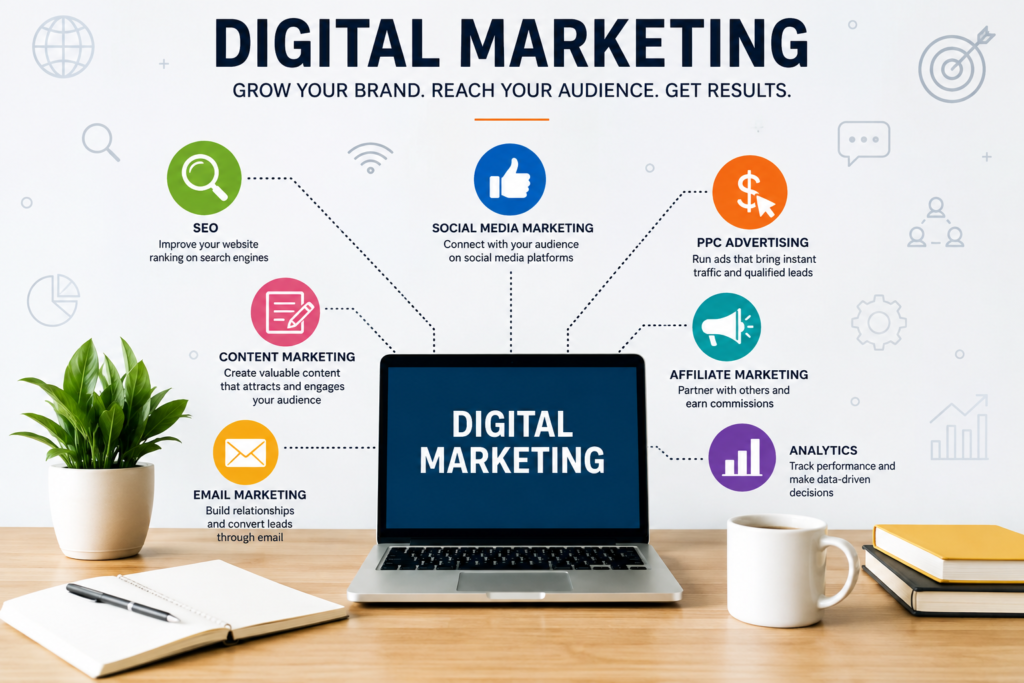
There are several digital marketing channels, and each one has a different purpose. You don’t have to master all of them immediately. Start with the basics and gradually explore the areas that interest you most.
Search Engine Optimization (SEO)
SEO stands for Search Engine Optimization. It involves improving a website and its content so that it can appear higher in search engine results.
For example, if you search for “digital marketing tips for beginners,” Google displays several relevant pages. Websites that follow good SEO practices have a better chance of appearing in those results.
SEO usually includes:
- Keyword research
- Helpful and relevant content
- On-page optimization
- Technical SEO
- Internal linking
- Website performance
- Building website authority
One important thing to remember is that SEO is not an overnight strategy. It usually takes time to produce results, but the traffic it generates can become valuable over the long term.
Social Media Marketing
Social media marketing involves promoting a brand, product, or service through platforms such as Instagram, Facebook, LinkedIn, YouTube, and other social networks.
Businesses use social media to:
- Increase brand awareness
- Connect with their audience
- Share useful content
- Build communities
- Generate leads
- Promote products and services
But successful social media marketing is more than posting promotional content every day.
People usually follow accounts that give them something useful, entertaining, educational, or relatable. That’s why understanding your audience is important.
Content Marketing
Content marketing focuses on creating and sharing valuable content to attract and engage an audience.
Content can include:
- Blog posts
- Videos
- Infographics
- Guides
- Social media posts
- Case studies
- E-books
- Podcasts
For example, instead of constantly telling customers to buy a skincare product, a skincare brand could publish an article about choosing products for different skin types.
That content can attract people who are already interested in skincare and gradually introduce them to the brand.
Good content doesn’t just promote something. It answers questions, solves problems, or provides useful information.
Email Marketing
Email marketing involves communicating with customers or subscribers through email.
Businesses can use email to share:
- New products
- Offers and discounts
- Blog updates
- Newsletters
- Educational content
- Personalized recommendations
For example, when you subscribe to an online store, you may receive an email welcoming you and later receive product recommendations or special offers.
Email marketing can be especially useful because it allows businesses to communicate directly with people who have already shown interest in their brand.
Search Engine Marketing and PPC
PPC stands for Pay-Per-Click advertising. It allows businesses to display paid advertisements on platforms such as search engines and social media.
For example, when someone searches for a service on Google, sponsored results may appear above or below the organic results.
With paid advertising, businesses can target audiences based on factors such as:
- Keywords
- Location
- Interests
- Demographics
- Online behavior
The advantage is that businesses can reach potential customers quickly. However, paid advertising needs proper planning and monitoring because spending money does not automatically guarantee good results.
Affiliate Marketing
Affiliate marketing is a performance-based marketing method.
In simple terms, a person or website promotes another company’s product or service using a special link. If someone makes a purchase through that link, the affiliate may receive a commission.
You may have seen this on blogs, YouTube channels, or social media accounts where creators recommend products and provide links to them.
Why Is Digital Marketing Important for Businesses?
People spend a significant amount of time online. They search for information, compare products, read reviews, watch videos, and communicate with brands through digital platforms.
Because of this, businesses need to be where their potential customers are.
Digital marketing can help a business:
- Reach a wider audience
- Build brand awareness
- Generate leads
- Increase website traffic
- Communicate with customers
- Promote products and services
- Measure marketing performance
It can also be useful for small businesses and individuals who may not have a huge marketing budget.
For example, a small local business can create a Google Business Profile, build a social media presence, publish useful content, and optimize its website without spending a huge amount on traditional advertising.
Benefits of Digital Marketing
One of the biggest advantages of digital marketing is the ability to measure performance.
With traditional advertising, it can sometimes be difficult to know exactly how many people saw an advertisement and what action they took afterward.
Digital platforms can provide useful data such as:
- Website visits
- Clicks
- Engagement
- Leads
- Conversion rates
- Ad performance
- Email open rates
This information helps marketers understand what works and what needs improvement.
Another major benefit is targeting. Instead of showing the same message to everyone, businesses can create campaigns for specific audiences.
For example, a company selling professional courses can target students, graduates, working professionals, or people interested in a particular skill.
How Can Beginners Start Learning Digital Marketing?
If you’re just starting, don’t feel pressured to learn every tool and strategy immediately.
Start with the fundamentals.
Step 1: Understand the Basics
Learn what SEO, social media marketing, content marketing, email marketing, PPC, and analytics mean.
Once you understand the purpose of each channel, the bigger picture becomes easier to understand.
Step 2: Learn SEO
Start with keyword research, search intent, on-page SEO, title tags, meta descriptions, headings, internal links, and basic technical SEO.
Try optimizing your own website or blog. Practical experience can teach you much more than simply reading definitions.
Step 3: Practice Content Creation
Write blog posts, create social media content, design simple graphics, or experiment with short videos.
The more you practice, the easier it becomes to understand what attracts and engages an audience.
Step 4: Explore Analytics
Learn how to read basic marketing data.
You don’t need to become a data expert immediately. Start by understanding metrics such as traffic, clicks, engagement, conversions, and bounce rate.
Step 5: Build Your Own Projects
This is one of the best ways to learn.
Create a simple website, start a blog, manage a social media page, or create a small practice campaign.
When you work on real projects, you’ll encounter problems that tutorials cannot always prepare you for.
Common Digital Marketing Mistakes to Avoid
Beginners often make a few common mistakes.
Trying Everything at Once
SEO, social media, email marketing, PPC, content, analytics — there is a lot to learn.
Trying to master everything simultaneously can become overwhelming. Start with one or two areas and build from there.
Focusing Only on Promotion
If every post says “Buy now,” people may stop paying attention.
Create content that educates, entertains, or helps your audience as well.
Ignoring Your Audience
A strategy that works for one business may not work for another.
Before creating content, ask yourself:
Who am I trying to reach? What do they need? What problems are they trying to solve?
Expecting Instant Results
Digital marketing often takes time.
SEO may require consistent effort before noticeable results appear. Social media growth also takes patience. Paid advertising can produce faster traffic, but it still needs testing and optimization.
Instead of looking for instant results, focus on learning, testing, measuring, and improving.
Final Thoughts
Digital marketing can look complicated when you first enter the field, but it becomes much easier once you understand the basics.
You don’t need to know every platform, tool, or strategy on day one. Start by understanding your audience, learn the main digital marketing channels, and practice what you learn through real projects.
Whether you want to promote a business, build your personal brand, start freelancing, or develop a career in marketing, digital marketing gives you plenty of opportunities to learn and grow.
The best way to learn isn’t just to keep reading about digital marketing.
Start practicing it. Create something, test it, measure the results, learn from what happened, and try again.
You can also learn more about how Google Search works from Google Search Central.
That’s where real digital marketing skills begin.